GCSE Grades Explained: The 9-1 Grading System
The quick answer
GCSEs in England are graded 9 to 1, with 9 being the highest. A grade 4 is a ‘standard pass’ (equivalent to the old C grade), and a grade 5 is a ‘strong pass’. You need at least a 4 in English and Maths to avoid compulsory resits.
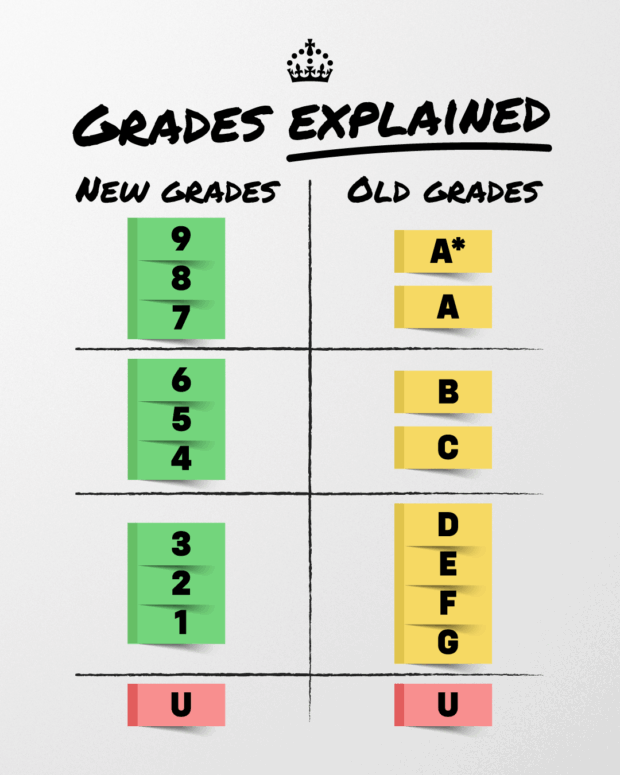
Source: Department for Education
Why did GCSE grades change from letters to numbers?
The switch from A*–G to 9–1 happened in England between 2017 and 2019 as part of wider GCSE reforms. The new system was designed to:
- Better differentiate between the highest-achieving students (the old A* has been split into grades 8 and 9)
- Signal reformed content — so employers and universities can tell the difference between old and new GCSEs
- Provide more granularity — nine grades instead of eight gives a finer scale
Wales and Northern Ireland still use the A*–G letter system for most subjects. Scotland uses its own National 5 qualifications.
9-1 grades vs old A*-G grades
Here’s how the new number grades map to the old letter grades:
What grade is a pass at GCSE?
There are two ‘pass’ levels in the 9-1 system:
Equivalent to the old grade C. This is the level the government considers a ‘pass’.
Between the old B and C. Some sixth forms and employers treat this as their minimum requirement.
Important: If you don’t achieve at least a grade 4 in English Language and Maths, you’re required to continue studying these subjects and resit them. This rule applies until you turn 18.
What grades do you need for sixth form or college?
Entry requirements vary, but here’s a general guide:
| Route | Typical requirements |
|---|---|
| A-Levels (sixth form) | Grade 5+ in most subjects, often 6+ for competitive subjects like Maths, Sciences, or English |
| BTEC / T-Levels | Grade 4+ in English and Maths, plus 4+ in relevant subjects |
| Apprenticeships | Grade 4+ in English and Maths (some require 5+) |
Always check with your preferred sixth form or college — requirements differ between institutions and courses.
How are GCSE grades awarded?
Exam boards (AQA, Edexcel, OCR, and WJEC) set grade boundaries after marking is complete. The boundaries change each year depending on how difficult the papers were. Key points:
- Grade boundaries are set after the exams, not before — so you won’t know the exact marks needed until results day
- Different tiers have different grade ranges: Foundation tier typically covers grades 1–5, while Higher tier covers grades 4–9
- If you sit Higher tier and score below a grade 4, you may receive an ‘allowed grade 3’ — but below that is Unclassified (U)
- The grade 9 is deliberately harder to achieve than the old A* — it’s intended for the very top performers
📝 Ready to start revising?
The best way to prepare for your GCSEs is to practise with real past papers. We’ve got hundreds of free papers from AQA, Edexcel, OCR, and WJEC.
Sources
📅 When is GCSE Results Day 2026?
Results Day is Thursday 20th August 2026. Find out what time results are released, what to bring, and what to do if grades aren’t what you expected.
Read the full Results Day guide →

